
DEV-TALK - 010: Do I Really Need Ardenfell?
Yes

Jokes aside though, what does Ardenfell really bring to your game or taking it a step larger; what is the value add of system agnostic setting guides and tailored TTRPG content like the City of Ardenfell Setting Guide and Coming Storm Adventure Path? Well, that’s what I’m going to talk about this time around SO BUCKLE UP. Also, thanks to those who’ve checked in/reached out with this little hiatus I’ve taken on updates here! I’ve been working on this post for a bit, but have been enjoying a bit of rest and self improvement work as we get ready to re-launch the Kickstarter in the next few months. Things are moving quicker now, and I think that it’s a great time to give an overview of what makes our project unique, and why I think it’s worth backing. I’m going to focus on three main pillars: Modularity, Ease of Use, and Aesthetic.

Part One: Modularity From the Ground Up
The first thing that you’ll notice when interacting with our work is how modular it is. This book has gone through several (some painful) iterations as I wrestled with the very question above. When I started this a few years back, it was part of a writing exercise for my D&D game, so naturally I started writing it within the confines of 5th Edition. However as time went on and I began to design more things, I started to have a lot of fun making stuff for other systems like Blades in the Dark, Mork Borg, and Daggerheart. Over time I realized that I didn’t want my homebrew world to be unintentionally bound by the design choices and philosophy of Dungeons & Dragons, I wanted that decision to be up to the person using it! Magic in my homebrew world is a bit different than standard D&D, and I’m sure in your game and at your table you have your own intricacies and unique bits that can’t be perfectly boxed into any one system… And that was what really kicked off turning this from a solo, part-time exercise into a real project with a team.
That’s a lot on the ‘how’ I landed on making things more agnostic design wise, but where’s the examples? Where’s the MEAT?! Well, the beauty of designing everything with one system in mind, and then going back and reworking it from the ground up is you get a REALLY interesting look at the barebones mechanical bits of a setting guide / adventures. As we started rebuilding everything I’d messily thrown together, I decided that I really wanted to make every encounter, location, NPC was built in such a way that almost any GM could quickly look it over, understand it, and then reshape it to fit their needs in just a few moments. Each locale has a couple different hooks that are designed to give a GM easy and interesting ways to tie their players to the world that GM made. Have a player with an occult backstory? Here’s a location and a mini-encounter that you can easily modify, turning it into a big moment for that player’s backstory while also giving chances for others present to get involved.
Both our products are built in such a way that both new and seasoned GMs can easily take what works, and leave what doesn’t. Like a specific neighborhood? You have the history and background info you need to quickly modify it to fit a city of your own! Like a few taverns or shops? You can easily take them and slip them into a part of your city that seems fitting, or use them as signature elements that inform the rest of your design. Our motto is ‘Take what works, leave what doesn’t!’ and I really believe that what we’ve made makes doing just that a breeze.

Part Two: It’s Easy to Use!
I mentioned a little bit above how easy it was to use our product, ‘but HOW easy is it?’ I pretend to hear you asking. Well, I’ve rather conveniently made a whole post showing an example of how I was able to quickly convert one of our encounters into Daggerheart in just a few minutes. Now to be fair, our agnostic design system and Daggerheart share a lot of design similarities that made doing so EVEN easier (seriously our stuff works super well with Daggerheart) but I’ve done the same thing with Blades in the Dark, Mork Borg, and 5th Edition with equal success. I intend to continue in the long tradition of making a blog post about how to use a variety of homebrewing tools to quickly prepare for a session, make unique monsters your own, and all that fun stuff for 5th Edition, but I say it that way because there are already dozens of EXCELLENT posts, books, and more on the topic that have done so with much more depth than I’ll ever be able to go. So instead I think it’s best to just show how easy it is to use with one of my favorite monsters that you’ll run into on the streets of the Glasswork Hollow… The Molten Glass Elemental!
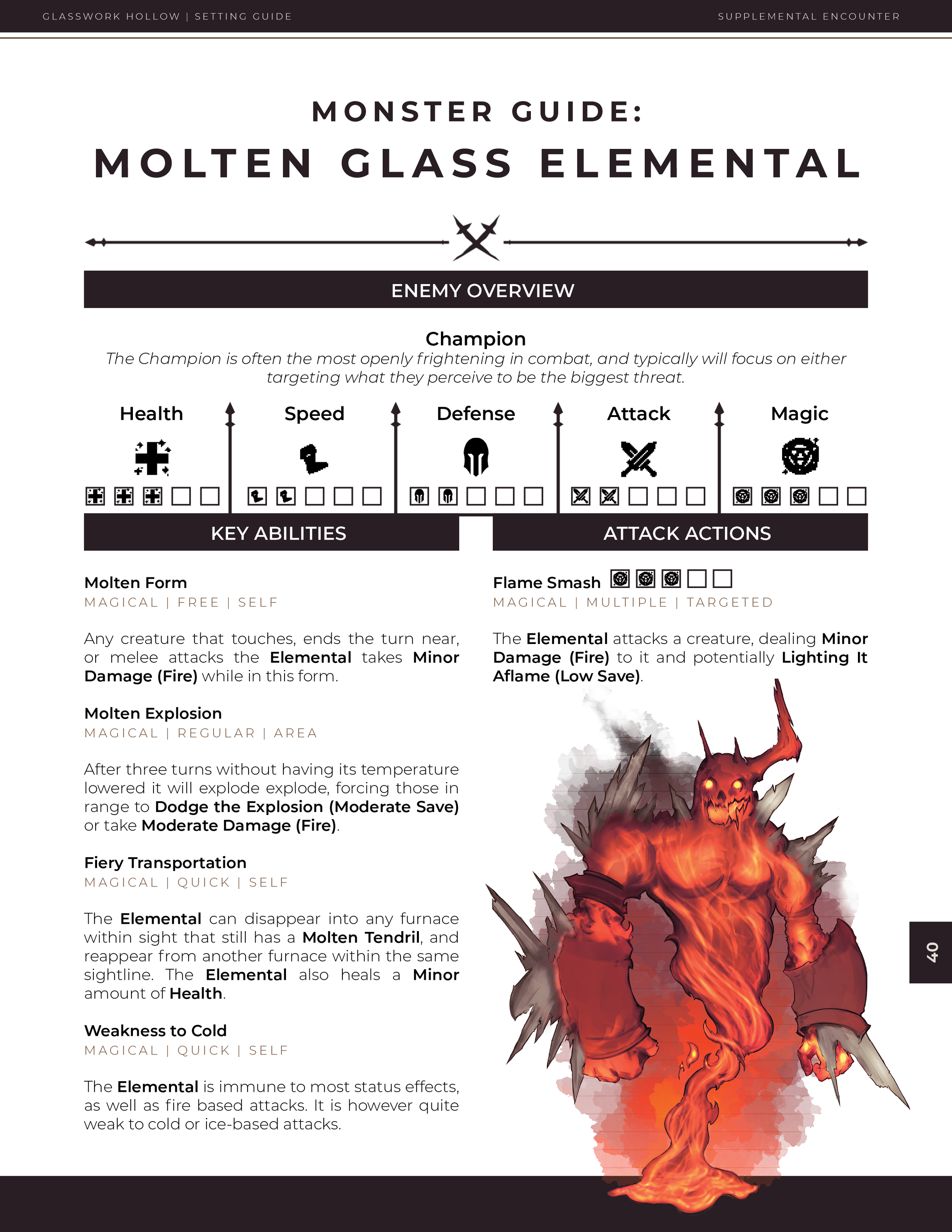
So the first thing we have here is the Enemy Overview section, which has a little bit about the creatures role in combat, along with five general ‘stats’ to get an idea of their strengths and weaknesses. There is a page dedicated to “Using The Setting Guide” which covers some general recommendations, along with a legend for the meanings of the ‘stats’ as well as the roles like Champion or Commander. The overview provides a simple enough description of their role in combat, so I’ll save posting the whole archetypes block here for now, but don’t worry; it’s in there! Instead, let me show you the rough stat scaling chart we use so you can get an idea of where the Molten Glass Elemental’s strength’s reside.
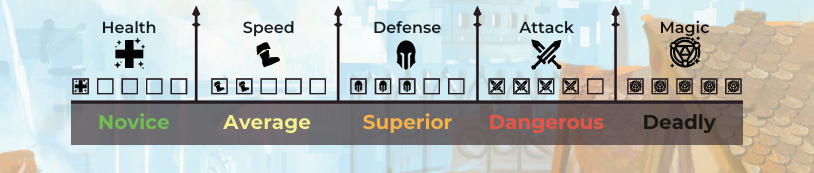
So we got a Champion type monster that’s going to go toe-to-toe with the party’s biggest threat, with an above average amount of health and magical ability. My strategy for monster building is the same across all systems; find something similar, then tinker with it into what I’m looking for, so that’s what we’re going to do here! Now, the next decision is 100% dependent on your GMing style; specifically if you like to ‘wing it’ a bit more or prefer to have everything planned down to the proficiencies the monster has. Here’s the two paths ahead of you to take:
If you’re more the ‘wing it’ type of GM, I’m going to take the sheet above, then head on over to the Lazy GM’s Monster Builder, Ctrl+F ‘Elemental’ and have the Flame Smash attack become the base attack which it can do 2-3 times (depending how brutal my game is) and add a Low Constitution Save, which I’ll set at 10 or they will take an additional 1d6 per round until they put the flame out or pass the save. I will also buff the health slightly, and since the Lazy GM’s table has a range, I’ll just go with the high end and set it at 120hp. I’ll make a note that it’s vulnerable to Cold damage, immune to Fire damage, and apply 1d10 fire to anyone who ends a turn nearby the creature, or touches it directly (because that’s what you do with fire guys). Finally, I’ll look at the good ol’ Fireball spell for the Molten Explosion effect, and set the Dexterity Save to 14 or 15 as a Moderate Save.
If you’re the more deliberate type of GM who likes to have every stat block built out, don’t worry! We’re still going to go about the same process, just with a different set of tools. This time I’m going to make my way over to RPGBot’s Monsterizer and follow the tool prompts, searching a Fire Elemental, and get started tinkering. Like above I’ll set the vulnerabilities and immunities, follow the prompts and end up in basically the same place! The Monsterizer does a fantastic job walking designers through each step of the design, letting you modify stats, proficiencies, abilities, so in this scenario I’m probably spending a bit more time theorycrafting damage amounts by turning Molten Explosion into a Fireball-like feature, and slightly upping the basic attack damage or attack bonus.
The first approach took me all of 2-3 minutes to have copied and pasted hastily into my notes and was ready to be run. The second approach took a bit longer because, well, I got a bit distracted tinkering with proficiencies for no real reason. That said, the second approach took me a little more than 5 minutes to save as a png and toss in my aforementioned notes. Now I’m of course more familiar with my creations and the like than you will be, but you get the point. Additionally, if you’re a more seasoned ‘wing it’ GM, you can probably look at these overviews and make a sheet in your head and run them off the cuff! I don’t recommend it but hey, I’m not your supervisor!

Part Three: Aesthetically Pleasing Trauma
Last but certainly not least, we have the aesthetic angle of the City of Glass. I’ll level with you, I fucking love Ardenfell. I know everyone loves their darlings and all that, but you have to understand me when I tell you this is different. Originally Ardenfell wasn’t even in MY world, when I first started I wasn’t planning on having anything I made be tied to any lore; everything was going to be it’s own isolated entity for MAXIMUM MODULARITY but as I shifted gears with this project to really try and publish something, I started to want it in my own homebrew world. But why?
If I was giving you a one-sentence sales pitch for what makes this city so interesting (which I guess I am doing) I’d offer you this:
Ardenfell is what you get when Batman’s Court of Owls watched too much of The Bear.
It’s a city where everyone views themselves as an artist, and their work is an extension of that art. It’s a bustling, wealthy city that is built upon old lies and ancient, evil magic it can’t ever fully escape. It’s a place where all the things that made it great are destined to spell it’s downfall, and a place where a party of adventurers are EXACTLY what’s needed to save the city from itself. Ardenfell is clearly beginning to lose its way, and the way that locals avoid talking about the Warrens as well as the Founding Families hints at that the moment players begin to scratch beneath the surface. I think the feeling those unsaid things create is what makes Ardenfell so fun to explore from the player’s point of view; they can feel that something is off before they can prove it, which naturally makes them want to explore all the more.
Additionally, I feel like each neighborhood has it’s own personality that clearly informs the behaviors of those that inhabit it, which gives the party another element to interact with. Got a party of ex-sailors? They’ll love the Harborfront. Maybe a bunch of magic users? Well then of course the Scholar’s Enclave is where they’re going to find lodging. A little bit of everything? Well then exploring the city becomes an adventure in itself as you use the encounters for each locale they visit. When playtesting a modified version Ardenfell in one of my games (I’m not only the Calamity Punk President, I’m also a client) one of the things I was most proud of was that after a bit of orientation, the party began using the distinct nature of each neighborhood to their advantage. They stopped asking me ‘where’s the best place to find X’ and started asking ‘where in the Floating Market can I find X’, and that’s how I knew I was on the right track.

Too Long, Didn’t Read
Many great setting guides and adventures are so system specific that trying to convert them for your game is simply too much work. Alternatively, a lot of system agnostic content can be so vague or light that it’s more of an idea prompt than usable guide. That’s where Ardenfell’s Setting Guide & Adventure Path comes in, where Adaptability meets Identity. It’s a setting that is highly modular, but has enough structure so you can easily figure out where to plug it into your world. It’s an adventure path with a distinct tone and narrative, but can easily be adapted for a number of different systems, and offers a number of different paths which your players can take. It’s got undead sea monsters, smuggled elementals, underground wizard duels, and an eldritch horror that’s been waiting centuries to escape.
It’s a city with a lot going on.
